
| Search PNC News for stories of people and churches in our UCC Conference: |
|---|
Trustees decide on drought resistant landscaping
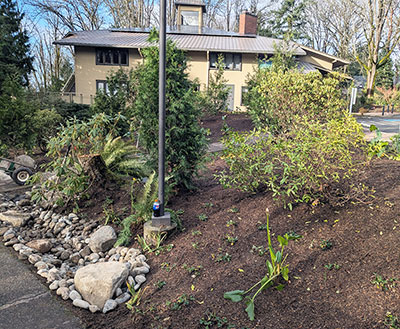
A magnolia tree dedicated to a former pastor, rhododendrons, mahonia trees and Japanese maple trees are being moved to different locations on the grounds of the Congregational Church of Mercer Island as part of relandscaping the property near the church to replace lawns with drought resistant landscaping.
The goal, said Diane Calvert, chair of the trustees and a member since 1987, is to save money from watering and landscaping.
|
Some of the plantings near the Mercer Island UCC building. |
Last year the water rate increased 180 percent. This year it will rise 8 percent and next year another 8 percent.
“Raccoons and crows dig up the grass sod every year looking for grubs,” she said. “Every year we had to replant the grass. We needed a landscaper to come every week to mow.
“We talked to our landscaper who said came up with plans for a drought-tolerant yard,” she said.
The plan includes planting new trees, different plants and transplanting plants already there.
“Our landscaper calls it moving the forest that is behind us to the front,” said Diane, a retired nurse, who grew up in Omaha and lived in Spokane several years before moving to Seattle in 1970.
He and his crew finished the job in December, so the only grass is along Island Crest Way, the main street of Mercer Island.
Now in two large areas adjacent to the church there are 17 excelsia cedar trees that are six-foot and 14-foot. They will grow to 30 feet tall.
Other plants include calla lilies, camelias, iris, short ferns and ground covers like vinca, hellebores, oxalis, oregana, lippinella, fragaria philoensis and fragaria vesca.
“There will not be immediate savings. It will take perhaps two years for the plants to establish a strong root base so they need less water,” said Diane. “Then we will need landscaping services just monthly rather than weekly and we will be doing less watering.”
The total for the project was $70,000 which came from savings, with expectation that the savings will be recouped, and from donations of members who purchased specific trees or plants for specific amounts, like $300 for ground cover, or different amounts for a six-foot or 10-foot tree.
Some of those gifts are in honor or memory of someone and will be recognized by a plaque on a stake in the ground near the plant.
Drought landscaping the yard is not the church’s first or only venture in environmental action and consciousness raising.
Diane said that eight years ago the church put solar panels on the roof. In the summer months, power generated by them for the church means they pay for only a $23/month service fee from May to October.
“Our church is environmentally aware,’ she said. “We recycle what we use and compost the yard waste. We use compostable products for receptions and dinners and encourage those who have weddings to also use compostables.”
The church also participates in Ridwell, a Seattle program that takes products to recycle that are not picked up in the city’s curbside program.
It picks up products like plastic bags, plastic film, batteries, textiles, old clothes, light bulbs, corks, metal bottle caps old jewelry, chargers, eyeglasses and medicine bottles.
Members bring items to the church, and one member sorts them in bags that are put out in a box for Ridwell to pick up weekly. Ridwell has local business partners that wash, sort and process items for reuse or recycling.
The program keeps waste out of landfills. The church pays for the service.
Every few years, the Congregational Church of Mercer Island will arrange a recycling day for a recycling company to park a truck outside the church and spreads the word for people in the community to bring electronics—computers, TVs, cell phones or other types of recyclables. It’s usually filled in three to five hours
Members not only attend presentations on the environment and conservation but also share information on environmental actions they are taking at the church's booth at Mercer Island street fairs and events at parks.
“Our church is energized to do our part for the environment,” said Diane.
For information, email dianec0529@msn.com.
Pacific Northwest Conference United Church of Christ News © January 2026
Share this article on your favorite social media 