
| Search PNC News for stories of people and churches in our UCC Conference: |
|---|
Office hours with conference minister sparks discussion on covenant
At several recent Office Hours with the conference minister, those gathered have shared discussed covenant relationships among the local churches and with the conference and national UCC.
Some UCC members may focus on their own congregation, but many find nurture and nurture others to be stronger in their faith and gain ideas to improve their leadership, education, advocacy and outreach because through their covenantal relationship with the conference, national and global ecumenical church. As the PNC seeks new nominees and leaders, it’s a time to reflect on covenant.
While UCC polity is local-church based, it is a connectional covenantal denomination.
Banners hanging around the upper walls at Stillwater Lodge at N-Sid-Sen express some of that covenantal relationship of their churches with other UCC churches and the wider church: “United to serve.” “More light and faith.” “One in the bond of love.” “We are the hands and feet of God.”
Those are a few expressions of the covenant spirit.
The Annual Meetings, board meetings, committee meetings, camps and retreats, the weekly PNC News, the PNC-UCC News quarterly newspaper and the conference staff all work to strengthen the clergy, lay leaders and members of congregations.
The national website describes the United Church of Christ as “an inclusive and diverse community of Christians connected by faith that calls us to build a just world for all. Our ministries advocate at a national and global level, but our roots are planted firmly in our local churches in communities. It consists of 4,794 local churches, 773,000 members, 10,000 authorized clergy and 300 global partnerships.
The national leadership includes elected its officers, board members and national staff associates who work together to support local church leaders.
The UCC has 33 conferences that send delegates every three years to the national General Synod.
In a time of transition in conference minister leadership that has lasted four years since Mike Denton left in 2022. Often that role is what cements the ties, but with different people in that role, more is left to the overall glue of covenant.
PNC News editor Mary Stamp offered an email invitation for conference members and leaders to share that covenant means to them.
Four shared comments. They are people who have been involved in the conference in various ways for various years, offered as an invitation for others to think about their participation, interaction and enrichment from their associations in the region.
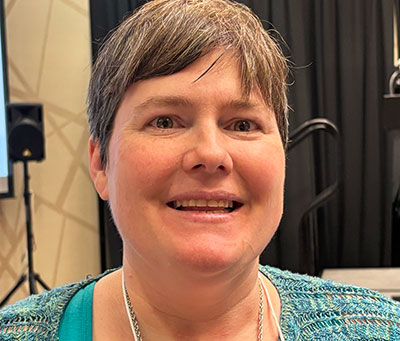 |
Sandy Wisecarver, moderator for the PNC-UCC. |
Sandy Wisecarver, PNC Board moderator and pastor at Blaine UCC, came to the UCC 15 years ago from the United Methodist Church.
She finds that the congregations, conference and national church strengthen her ministry.
“We can do more together. If we join together across churches, we can reach more. We can support each other,” she said.
When the elevator at the Blaine church failed, they approached the conference which provided funds to help repair it.
“We believe in helping others beyond our local church, so we give to all five designated national UCC offerings,” she said.
“When there were bills for No Hate Washington proposed, we learned about them at a board meeting. I shared the information with our church, and we joined in the advocacy to laws pass those bills in the state,” Sandy continued.
She also appreciates the PNC email listserv as a resource where people around the conference post information on events, concerns and ideas.
“I look at Weekly Seeds on national UCC website for ideas for sermons for the week based on the lectionary,” she added.
In the Come and See videos for Annual Meeting, Sandy learned what churches across the conference were doing. They are posted on the PNC YouTube page as a resource and continue to give ideas on what churches might do and on different ways to be the church.
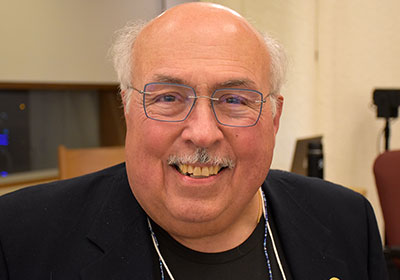 |
Ron Patterson, scribe for the Board of Directors |
Ron Patterson, who came to the PNC 10 years ago after retiring in Florida, brings experience on the local, conference and national levels of the UCC, including attending every General Synod of the national UCC since 1977. He served as pastor of churches in Ohio, New York and Florida, retiring from a 1,200-member UCC church in Naples, Fla.
“I have served on the UCC national board, executive council and was moderator in three conferences. I’m now on the nominating committee for the national board of the UCC,” he said.
Ron, who is scribe on the PNC Board, has seen a more positive spirit in the conference, beyond financially, during the last two years ago.
“I’m speaking of the spirit I have experienced at recent installations of new pastors and in the active engagement of local churches and pastors,” he explained.
“That spirit was demonstrated by the ‘Come and See’ videos churches prepared for Annual Meeting,” he added.
Fifth graders in his Sunday school class prepared the video for his church, Fox Island UCC.
“Our conference has many churches where exciting things are happening,” he noted.
“For me, the connection of churches is enhanced as clergy hold one another accountable and support one another emotionally, while striving for excellence in local churches that empower local leaders through mission,” Ron said.
For example, his Sunday school went to Tacoma to give lunches to detainees when they were released from the Immigration and Customs Enforcement (ICE) Detention Center in Tacoma.
“If a local church gets mission right everything else falls in place. Giving follows enthusiasm. People are excited when other people are excited,” he said of the opportunities created as churches connect with each other.
“No one joins a church to pay the gas bill,” said Ron, who comes from a German Reformed background and has been involved with the UCC wider church since 1974.
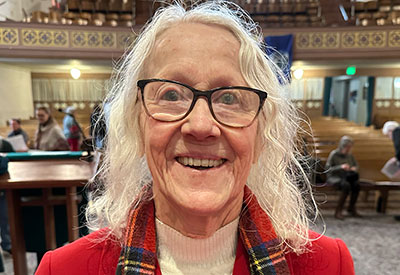 |
Morag Stewart, member of the Board of Directors |
Morag Stewart, a member of the Board of Directors, and former member of Cheney UCC who transferred to Westminster UCC in Spokane, spent her K-12 education in Scotland, where there is no separation of church and state and religious education is in the public-school curriculum. Like in most European countries, it is difficult to separate history and religion. They are frequently intertwined. She brings historic, European and Presbyterian perspectives.
Morag was introduced to covenants at an early age with the 1638 Scottish National Covenant, defending the Presbyterian Church from attempted reforms based on the Anglican church by then monarch King Charles I.
“The notable reform stems from King Henry VIII’s rule when he severed ties from Catholicism and made the English monarch head of the Anglican denomination. For Presbyterians, God is the head of the church. The Church of Scotland’s general assembly elects the moderator for a one-year term,” Morag explained.
In addition to those covenants, Morag heard about Covenanters, “members of a 17-centuary Scottish religious and political movement, who supported a Presbyterian Church of Scotland and the primacy of its leaders in religious affairs. In 1638, thousands of Scots signed the National Covenant, pledging to resist changes in religious practice imposed by (King) Charles.”
The covenants did not hold, so there were decades of religious wars involving Scotland, England and Ulster (Northern Ireland). At one time, a group of Covenanters were branded as outlaws and their Presbyterian worship was treasonous.
“Many were killed and buried in remote areas during the Killing Time. In the 17th century Kirk O’ Muir became a meeting place for Covenanters.
It’s in the Stirling area of Scotland, the region where Morag was raised. The Kirk was on a remote hillside that afforded visibility of those approaching, increasing the safety for participants.
When she joined a UCC church in the summer of 1988, the concept of covenant and covenantal relationships was vivid in her memory, understood from her background.
“During my years on the PNC Committee on Ministry Eastside, I found covenant a hard concept for some to understand and embrace, especially for those raised in hierarchical denominations that are organized like corporate structures.
“The UCC polity of covenant embraces relationships based on free-choice and a pledge to support one another,” Morag said. “It was the practice followed by the earliest disciples and modeled by Jesus during his lifetime.
“Power and authority are not invested in a few leaders, but in the collective body: the local churches, conferences and associations and the national UCC.
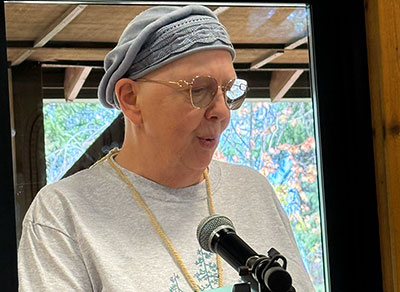 |
Dee Eisenhauser, retired pastor long active in PNC |
Dee Eisenhauer, who retired from Eagle Harbor UCC on Bainbridge Island, has been involved with conference from day one of her ministry and on conference committees and been doing volunteer work with the PNC for 40 years.
As a local pastor she tried to involve others on committees and at camps. She also insisted the church grant her a week of outdoor ministries in her contract. With her commitment to the wider UCC, she has served on boards and committees.
“Local pastors are tagged to be connectors and help maintain the vitality of the local church, camps, conference and national church,” Dee said.
How many are involved in the wider church ministries varies from church to church.
“In my experience, wider church connection is an obligation and a privilege,” she continued. “I am a big believer in collegiality, engaging with neighbor churches across state and community to consult with and learn from each other.
“In talking with other pastors, I have offered nurture and have been nurtured,” she said.
“As clergy we need to count on each other, bring our collective wisdom to common and unique problems in official and unofficial capacity. We need to put time into build meaningful relationships.
“Our system is a good one, but if a person has lone ranger or isolation tendencies, our system lets them do that to own peril. Those who are collegial benefit from the contributions of many,” Dee said. “Like any relationship, if we do not serve on a committee, volunteer at camp or go to Annual Meeting, we may feel the conference doesn’t care about us. With freedom, we need to have accountability.”
Pacific Northwest United Church of Christ Conference News © October 2026
Share this article on your favorite social media 